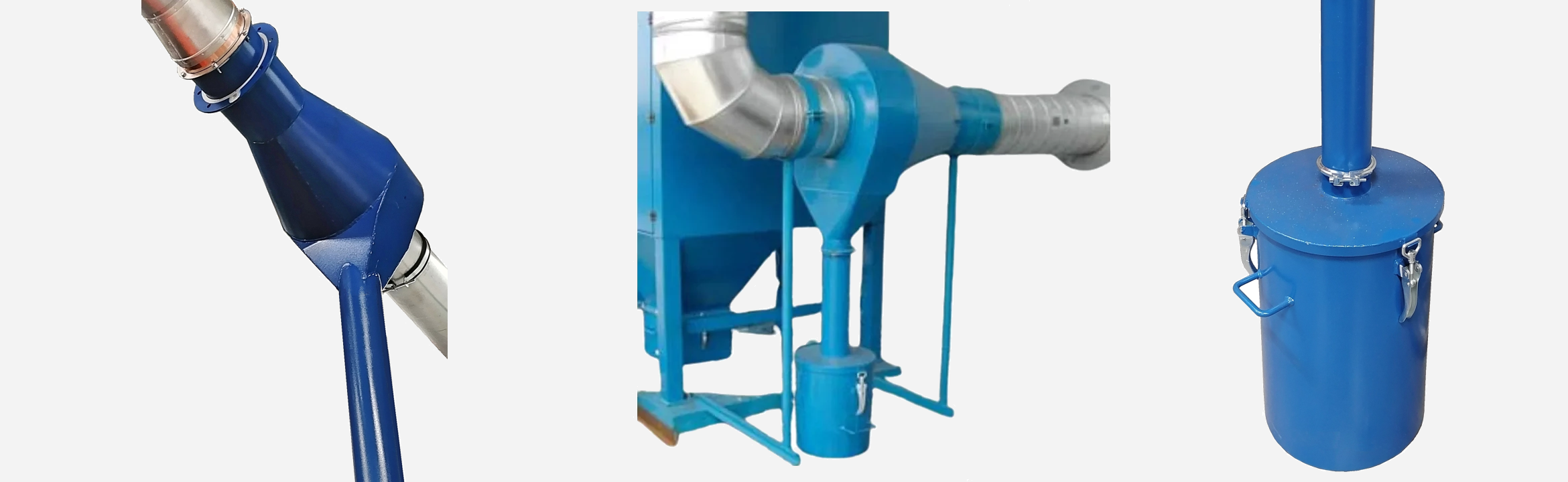
Spark arrestors
A spark arrestor is a passive in-line pre-separation and fire mitigation device installed upstream of a dust collector to intercept, separate, and extinguish incandescent particles, sparks, and hot embers before they enter the filtration system. It is commonly applied in industrial processes that generate ignition sources, including welding, abrasive grinding, laser cutting, plasma cutting, and other thermal or machining operations involving combustible dust hazards.
The spark arrestor operates without electrical power, sensors, or active controls, utilizing engineered airflow dynamics, internal baffles, expansion chambers, and impact surfaces to modify particle trajectories and reduce conveying velocity. As the contaminated air stream passes through the device, high-temperature particles with greater mass and inertia than the surrounding airflow are unable to follow rapid changes in airflow direction. These particles are separated from the primary air stream, impact internal surfaces, and lose kinetic energy, while the increased residence time allows heat transfer through convection, conduction, and radiation. This controlled cooling process reduces particle temperature below the ignition threshold, providing effective spark suppression and ignition source mitigation.
In addition to fire hazard mitigation, a spark arrestor functions as a coarse particulate pre-separator by removing larger contaminants such as metal chips, slag, grinding debris, and heavy dust particles before they reach the dust collector. By reducing the combustible and abrasive particulate load entering the filtration system, it helps minimize filter loading, reduce wear on filter media, extend filter service intervals, and improve the overall reliability, efficiency, and operational safety of the dust collection system.



 Catalog
 Login
Login
 Register for Better Prices